Dear Avenues Families,
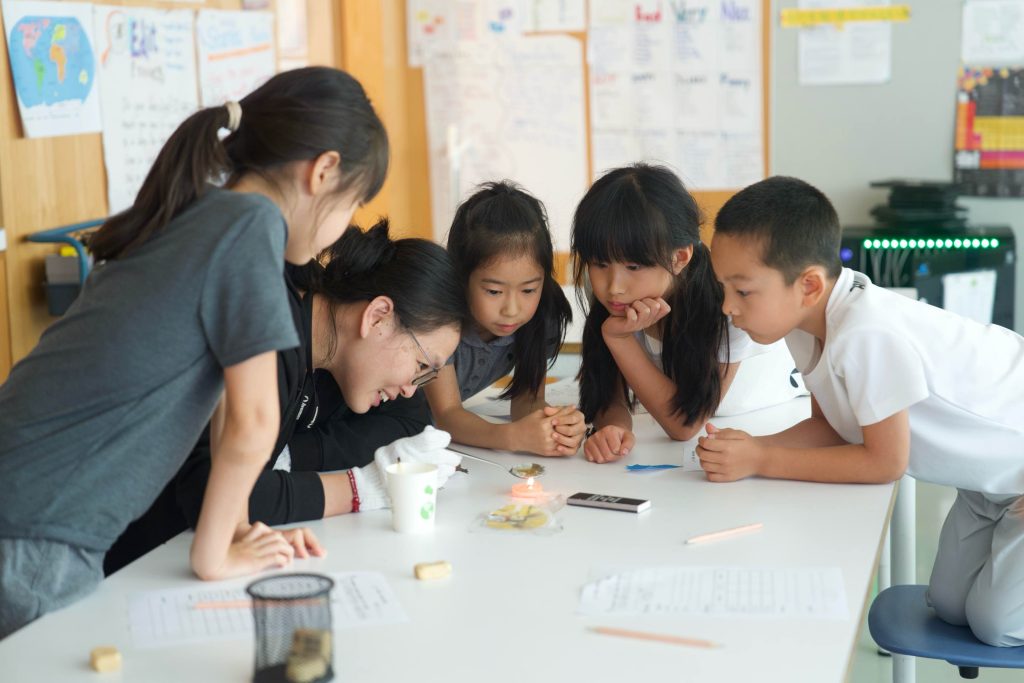
On Curriculum Night, I shared with you that your children do science and more through our intentionally designed curriculum that has 54 science-focused projects. I now want to address the question of, “How can project-based learning ensure strong science foundations?”
A valued approach to teaching and learning at Avenues is “learning by doing”. You may have heard this before here or elsewhere. Learning by doing is an approach where students actively engage with the teacher in the learning process vs. passively receiving the information from the teacher. This theory was supported by educational philosophers John Dewey and Paulo Freire, and educational consultant and author Richard DuFour. Now, research and theories are possibilities. What matters is student learning. I want to pause here and invite us to be critical thinkers. How do we know this approach is successful in ensuring students’ strong science foundation?
Our projects are based on purpose – to create a brain-based user’s guide to school, to write a children's storybook that sheds light on the challenges species face and instills a sense of responsibility toward the natural world, to design and engineer accessibility devices, to co-create a graphic novel tracing the narrative of the Big Bang to present day, to making decisions on the ethical guidelines for genetic engineering. And these are just 5 of the 54 science-focused projects. Let’s pause again. What do you think students need to know and do to be successful in these projects? Our teachers create experiences for students to learn the foundational scientific knowledge and skill they need to deliver these products at the end of the project.
In our current Project 1, life sciences, physical sciences and earth sciences are being studied. In Grade 3 students are studying the different lobes of the brain and are reflecting on how its function supports them in life. Grade 6 students are building a rich vocabulary in ecosystems so they can tell the story of their endangered species to Grade 4 students. Grade 8 students are learning coding through microbits so they can bring their assistive devices to life. Grade 9 students are studying the wavelengths of light and the redshift theory to understand how the universe is expanding. And Grade 12 students are studying the tension between nature vs. nurture in child behavior by observing and interacting with our Early Learning Center (ELC) students.
Now, let’s shift to our Mastery Program where our students have the opportunity to work with our two scientists in residence, Dr. Li Zheng and Dr. Tatsuhisa (Tatsu) Tsuboi. Dr. Li holds a Doctor of Science from Tsinghua University with academic experience in experimental physics and computational materials science. Dr. Tatsu holds a Ph.D. from Tohoku University in Japan and completed postdoctoral training at University of California Irvine and University of California San Diego before joining Tsinghua University in 2021. His research combines quantitative cell biology, advanced microscopy, and computer vision. In our Mastery Program, Dr. Li and Dr. Tatsu lead research workshops for our students and prepare them for science competitions. In addition, our teachers match the needs of students’ projects with Dr. Li’s and Dr. Tatsu’s experience. For example, Simon Liao is working with Dr. Li on his AI project while Josie Xu is working with Dr. Tatsu on her project about the causes of sleep paralysis.
In closing, I want to share one of the most valuable parts of our projects and the learning process - reflection. In a couple weeks, students will be sharing their products at their Showcases of Learning. I invite you, whether at the showcase or at home, to have a conversation with your child about their product and more so, about their process. John Dewey says, “We do not learn from experience. We learn from reflecting on experience.”. And while we base our pedagogy on research and experts, the best piece of evidence that we are being successful is found in our students; let them tell us what they know and let them show us what they can do because Science is knowledge and skill for a purpose.
In partnership,
Lisa Kopacka
Academic Excellence Coach, PBL
Avenues Shenzhen
Divisional Updates
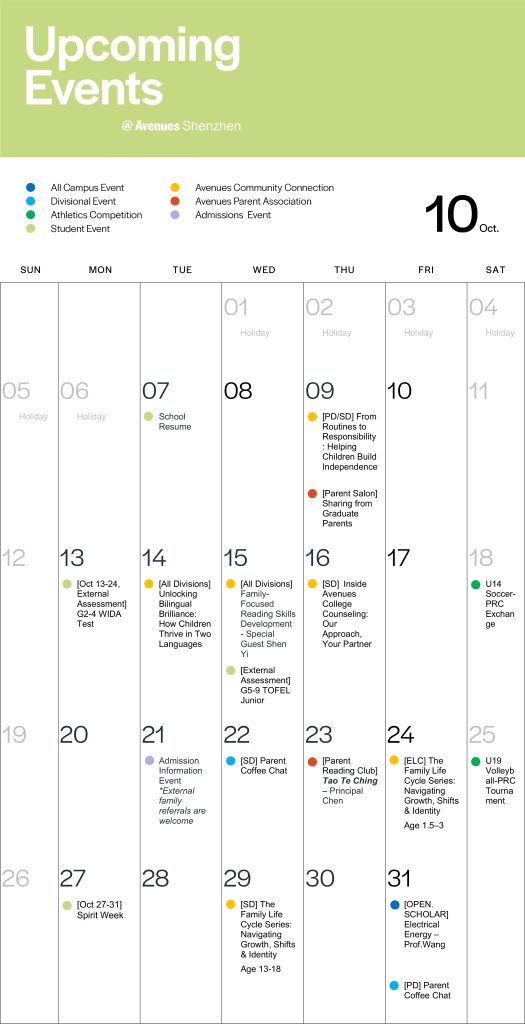
October Event Calendar
ACC
This week, the school will host three ACCs, covering topics on bilingual learning, reading skills, and college admission strategies. We warmly encourage you to check the schedule for each session and actively participate.
Unlocking Bilingual Brilliance: How Children Thrive in Two Languages
Date: October 14
Time: 8:20 a.m.- 9:20 a.m.
Speaker: Mariana Soller, Mia Xu
Venue: A12-300
How to Cultivate Children’s Critical Thinking and Humanity through Family Reading
Date: October 15
Time: 5:30 p.m. - 7:00 p.m.
Guest Speaker: Shen Yi
Venue: A19-MPR
Inside Avenues College Counseling: Our Approach, Your Partner
Date: October 16
Time: 8:30 a.m.- 9:30 a.m.
Speaker: College Counsellor Cathy Gao, Lu Yin
Venue: A12-300
Last Session Recap
Thursday, October 9, the ACC was held with the theme “From Routines to Responsibility: Helping Children Build Independence.” The session was led by Primary Division teacher Mia Liang and Academic Excellence Coach Pedro Ramos.
Starting from the concept of self-efficacy, the speakers used vivid examples and warm reflections to help parents understand how children develop independence and responsibility step by step—through hands-on experiences, learning from role models, positive encouragement, and emotional regulation. They also shared many practical tips that families can apply at home.
During the discussion and reflection segment, parents actively participated, sharing their own insights and takeaways. Many were inspired to rethink how to strike a balance between “letting go” and “being present.”
We sincerely invite more parents to join the ACC to learn, exchange, and grow together—supporting children as they move forward with greater confidence and independence.
You can view and save the PPT from this session for more details.
Divisional Updates
In addition to school-wide information sharing, each division also has important updates for your attention. Please click the link for the relevant division below to view the dedicated updates related to your child’s division.
Important Reminders
The 6th Chinese Language Festival — Registration Guidelines
Hosted by the Chinese Language Festival Association and co-organized by renowned international schools around the world, the 6th Chinese Language Festival is now open for registration for students aged 4 to 24.
This global celebration of the Chinese language aims to promote Chinese learning, provide participants with opportunities to appreciate Chinese culture, and showcase their creativity and talents through Chinese expression, performance, and communication. We warmly welcome all interested students to participate voluntarily!
The festival includes two competition streams — Native Speaker and Non-Native Speaker — and will be held simultaneously across eight global regions. Participants may choose from sixteen categories of competition, including:
Recitation, Reading Aloud, Storytelling, Speech, Singing, Dancing, Martial Arts, Variety Arts, Musical Instruments, Calligraphy, Writing, Pinyin, Painting, Design, Ancient Poetry Writing, and Modern Poetry Writing.
- For detailed information, please refer to the [Guidelines] .
- Registration, payment, and submission period: October 1, 2025 – March 31, 2026
- Result announcement: Within one month after submission
If your child is interested in joining, please click the Avenues Shenzhen exclusive link to register.
We look forward to seeing our students enjoy this inspiring experience and discover the beauty and power of the Chinese language!